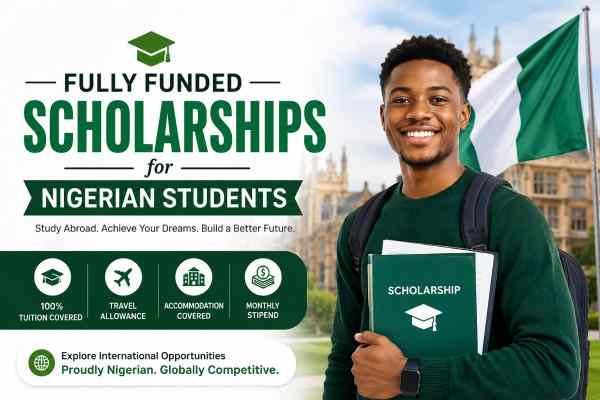
Fully Funded Scholarships for Nigerian Students: UK, USA & Canada Guide. Getting a world-class education abroad doesn’t have to drain your family’s savings or force you into a cycle of debt. Every year, thousands of Nigerian students secure fully funded scholarships to study in the United Kingdom, the United States, and Canada—covering not just tuition but living costs, flights, and health insurance too.
The competition is real, but so are the opportunities. If you know where to look, what to prepare, and how to apply strategically, your chances of landing one of these awards go up significantly.
This guide breaks down everything — the best scholarships, eligibility requirements, application tips, visa processes, and what happens after you graduate. Whether you’re a fresh undergraduate or a working professional eyeing a postgraduate degree, there’s something here for you.
Why Nigerian Students Should Consider Studying Abroad
Nigeria has some excellent universities, but global exposure carries a different kind of weight when it comes to career outcomes. A degree from a UK, US, or Canadian institution opens doors locally and internationally — and when that degree comes fully funded, the return on investment becomes even more compelling.
Beyond academics, studying abroad shapes your worldview, expands your professional network, and significantly boosts your earning potential. Many alumni of these programs go on to leadership roles in multinational corporations, international NGOs, and government agencies.
There’s also the immigration angle. Countries like Canada actively recruit international graduates through pathways like Express Entry and the Post-Graduation Work Permit (PGWP). Understanding the work permit after-study options before you even apply can help you choose the right program and country from the start.
Top Fully Funded Scholarships for Nigerian Students
1. Chevening Scholarships (UK)
Chevening is the UK government’s flagship international scholarship program, funded by the Foreign, Commonwealth & Development Office. It’s awarded to outstanding individuals with leadership potential.
The scholarship covers full tuition, a monthly living stipend, return flights from Nigeria, and a travel allowance. Recipients study at any UK university for a one-year master’s degree program.
To be eligible, you need a bachelor’s degree, at least two years of work experience, and must return to Nigeria after your studies for at least two years. Applications open in August each year.
2. Commonwealth Scholarships (UK)
Administered by the Commonwealth Scholarship Commission, these awards target students from low- and middle-income Commonwealth countries—which includes Nigeria. The focus is on sustainable development and leadership impact.
Both master’s and PhD scholarships are available. Funding includes tuition fees, a monthly living allowance, return airfare, and a personal baggage allowance. The application is done through your home country’s nominating agency in Nigeria.
3. Fulbright Foreign Student Program (USA)
The Fulbright Program is one of the most prestigious scholarship opportunities in the world. Run by the US Department of State, it awards funding to exceptional Nigerian students for master’s degree and Ph.D. programs at American universities.
The award covers tuition, living expenses, health insurance, and return airfare. Nigerian applicants apply through the United States-Nigeria Educational Foundation (USNEF). This program has strict academic and leadership requirements, so applying early and building a strong portfolio matters.
4. MasterCard Foundation Scholars Program
This program partners with several top universities globally to fund academically talented yet economically disadvantaged students. Many partner institutions are in the US and Canada, including Cornell University, the University of British Columbia, and McGill University.
Funding is comprehensive—full tuition, accommodation, living stipend, and mentorship. The program specifically targets students from sub-Saharan Africa, making Nigerians a key demographic.
5. Vanier Canada Graduate Scholarships
Designed for doctoral-level students, the Vanier Canada Graduate Scholarship awards CAD $50,000 annually for up to three years. It’s open to both Canadian and international students—including Nigerians—enrolled at eligible Canadian universities.
Selection is based on academic excellence, research potential, and leadership ability. Applicants must be nominated by a Canadian university, so securing admission first is a necessary step.
6. Gates Cambridge Scholarships (UK)
Funded by the Bill & Melinda Gates Foundation, Gates Cambridge Scholarships are awarded to outstanding students from outside the UK to pursue postgraduate study at the University of Cambridge.
Awards cover full tuition, a maintenance allowance, return flights, and academic development funding. Competition is fierce — fewer than 100 awards are given globally each year — but Nigerian students have won this scholarship.
7. Rhodes Scholarships (UK – University of Oxford)
The Rhodes Scholarship is one of the oldest and most recognized international scholarship programs in the world. Nigeria has its own constituency, which means dedicated awards exist for Nigerian applicants.
Recipients study at the University of Oxford and receive full tuition, a stipend, and health coverage. Beyond academic excellence, the selection committee looks for character, leadership, and commitment to service.
8. Trudeau Foundation Scholarships (Canada)
The Pierre Elliott Trudeau Foundation offers doctoral scholarships to researchers working on issues of social and public importance. International applicants, including Nigerians, are eligible to apply.
Each scholarship covers CAD $40,000 annually plus a travel allowance of CAD $20,000 over the scholarship period. The program also provides mentoring, networking, and community engagement opportunities.
Scholarship Comparison Table
| Scholarship | Country | Level | Coverage | Deadline |
|---|---|---|---|---|
| Chevening | UK | Master’s | Full (tuition + living + flights) | November |
| Commonwealth | UK | Master’s / PhD | Full (tuition + stipend + flights) | December |
| Fulbright | USA | Master’s / PhD | Full (tuition + living + insurance) | February |
| MasterCard Foundation | USA / Canada | Undergraduate / Master’s | Full + mentorship | Varies by university |
| Vanier CGS | Canada | PhD | CAD $50,000/year x 3 years | November |
| Gates Cambridge | UK | Master’s / PhD / MBA | Full + academic development | October – December |
| Rhodes (Nigeria) | UK | Postgraduate | Full (tuition + stipend + health) | August |
| Trudeau Foundation | Canada | PhD | CAD $40,000/year + travel | December |
General Eligibility Requirements
While each scholarship has its own specific criteria, most fully funded awards for Nigerian students share a common baseline. Understanding these requirements early helps you build the right profile over time.
Academic Requirements
- A minimum of a second-class upper (2:1) bachelor’s degree or equivalent—many competitive programs expect first-class results
- Strong academic transcripts from your undergraduate or postgraduate institution
- Relevant field of study that aligns with the scholarship’s priorities
Language Proficiency
- IELTS score of 6.5 or above (most UK programs require 7.0 or higher)
- TOEFL iBT score of 90 or above for US-based programs
- Some programs waive this requirement for applicants who studied in English-medium institutions
Leadership and Community Involvement
- Evidence of leadership roles — student union, NGO, professional associations, community projects
- A compelling narrative that connects your past work with your future goals
Work Experience (where required)
- Chevening requires a minimum of two years of work experience
- Some programs accept internships and volunteer roles as qualifying experience
Documents You Will Need
Document preparation is often underestimated. Gathering everything early — especially official transcripts and reference letters — saves you from last-minute stress. Here’s what most programs require:
| Document | Notes |
|---|---|
| Academic transcripts | Official certified copies from your institution |
| Degree certificate | Certified copy required for most applications |
| International passport | Must be valid for at least 6 months beyond intended stay |
| Personal statement / essay | Tailored to each scholarship’s criteria |
| Letters of recommendation | Typically 2–3; academic and/or professional |
| CV / Resume | Academic and professional experience clearly outlined |
| IELTS / TOEFL certificate | Valid within last two years; official test scores |
| Research proposal | Required for PhD applications; must align with supervisor’s work |
| Proof of admission (if required) | Some scholarships require university acceptance letter first |
How to Apply: Step-by-Step Process
Applying for fully funded scholarships isn’t something you do over a weekend. The most successful applicants treat it like a project—planned months in advance, with multiple review cycles.
Step 1: Research and Shortlist
Start by identifying scholarships that align with your field, career goals, and academic level. Don’t apply to every opportunity you find — focus on three to five programs where you genuinely fit the criteria.
A good university admission consultant or study abroad consultant near you can help you assess your competitiveness early. Many international student recruitment agencies also offer initial evaluations.
Step 2: Secure University Admission
Some scholarships (like Chevening) allow you to apply for the scholarship and university simultaneously. Others require a confirmed offer of admission before you can even submit the scholarship application.
Work with an education consultant to identify universities that align with your program goals and have strong outcomes for international students.
Step 3: Prepare Your Personal Statement
This is where most applicants win or lose the competition. Your personal statement needs to clearly articulate who you are, what you’ve accomplished, what you intend to study, and — critically — what you plan to do with the degree when you return to Nigeria.
Avoid vague ambitions. Scholarship committees read thousands of applications. Specificity, authenticity, and a compelling narrative are what set successful applicants apart.
Step 4: Request Reference Letters Early
Contact your referees at least six to eight weeks before the deadline. Give them a copy of your CV, your personal statement draft, and specific details about the scholarship so they can write targeted, compelling letters.
Step 5: Submit and Follow Up
Submit your application well before the deadline — ideally a week early. Keep copies of everything you submit. If shortlisted for an interview, prepare thoroughly using mock sessions and feedback from mentors.
Student Visa Application Process
Once you receive a scholarship offer, the next major step is securing your visa. The student visa application process varies by country, but the fundamentals are similar. Here’s what to expect:
UK Student Visa (formerly Tier 4)
To study in the UK, you’ll need a student visa. You must have a Confirmation of Acceptance for Studies (CAS) from your university, proof of English language proficiency, and evidence of financial maintenance (though scholarship awardees typically have this covered by their funding letter).
You can apply up to six months before your course starts. Biometric residence permits are issued on arrival. The visa typically allows you to work part-time (up to 20 hours per week during term time).
The UK also offers a graduate route visa that lets you remain in the UK for two years after graduation to seek employment — one of the key post-study work visa options currently available.
F-1 Student Visa (USA)
US-based scholarships require an F-1 student visa. After receiving your I-20 form from the university, you pay the SEVIS fee, complete Form DS-160, and attend an in-person visa interview at the US Embassy in Abuja or Lagos.
The study permit in the US (F-1 status) allows Optional Practical Training (OPT) — 12 months of work authorization after graduation. STEM degree holders can extend OPT to 36 months, making it an attractive post-study work visa option.
Study Permit (Canada)
Canada issues a study permit rather than a traditional student visa. You apply online through IRCC after receiving your letter of acceptance. Biometrics are required as part of the process.
The Post-Graduation Work Permit (PGWP) allows graduates to work in Canada for up to three years, depending on the length of their study program. This work experience often contributes valuable points toward a permanent residence application through Express Entry—making Canada one of the most immigration-friendly study destinations for Nigerian students.
Budgeting for Your Studies Abroad
Even with a full scholarship, you’ll encounter costs that aren’t always covered. Smart financial planning from day one prevents unpleasant surprises during your studies.
What’s Usually Covered
- Tuition fees
- Monthly living stipend
- Return airfare (for most programs)
- International student health insurance
What You Might Still Need to Budget For
- Visa application fees and biometric costs
- Airport transfers and initial settling-in costs
- Books, course materials, and lab fees
- Personal clothing and seasonal outfits (the UK and Canada get cold)
- Short trips or travel during semester breaks
- Mobile phone plan and internet setup
For education financing options beyond your scholarship, many Nigerian students explore education loans without collateral through fintech lenders and diaspora-focused financial institutions. Always understand the repayment terms before committing.
Tuition fee transfers abroad and living expense transfers from family in Nigeria often work best through licensed international remittance providers—compare rates before choosing one.
Work Permits After Study: Your Options
One of the biggest questions Nigerian scholarship alumni ask is, “Can I work after graduation?” The answer is yes—and the opportunities depend on the country.
UK: Graduate Route Visa
The UK’s Graduate Route allows international students who have completed a degree at a UK university to remain in the UK and work (or look for work) for two years (three years for PhD graduates) without needing a skilled worker visa sponsor initially.
After that, transitioning to a Skilled Worker Visa is an option if you secure a qualifying job offer. Understanding skilled worker visa requirements early helps you target employers who are licensed to sponsor international graduates.
USA: OPT and H-1B
After completing studies on an F-1 visa, graduates can work through Optional Practical Training (OPT) — up to 12 months, or 36 months for STEM graduates. The next common pathway is the H-1B skilled worker visa, though it’s subject to an annual lottery.
Working with an immigration attorney consultation service is strongly recommended for navigating the US immigration system after graduation. The best immigration law firms in the US offer structured guidance for international graduates exploring long-term visa options.
Canada: PGWP and PR
Canada’s Post-Graduation Work Permit (PGWP) is arguably the most generous post-study work permit in the world for international graduates. You can work in Canada for up to three years after graduation—and that experience counts heavily toward Express Entry points and permanent residence applications.
Many Nigerian graduates in Canada use the Express Entry points calculator to estimate their Comprehensive Ranking System (CRS) score and plan their PR after-study timeline accordingly. Provincial Nominee Programs (PNPs) offer additional pathways for those who don’t score high enough through the federal Express Entry pool.
Consulting with an immigration consultant fees-transparent advisory firm in Canada before your graduation helps you plan your PR strategy well in advance.
Permanent Residence Opportunities
Beyond work permits, some Nigerian students set their sights on permanent residence in their host country. This is a legitimate and increasingly common goal, especially for Canada-based graduates.
Canada’s Express Entry system awards points for Canadian work experience, education, language skills, and age. Graduates with a Canadian master’s or PhD degree plus Canadian work experience often accumulate competitive CRS scores. The Canadian Experience Class (CEC) is a direct PR pathway for those with at least one year of skilled work experience in Canada.
In the UK, the route from a graduate visa to indefinite leave to remain (ILR) typically involves working in the UK for several years under a skilled worker visa. The process requires continuous lawful residence and meeting income thresholds. A UK-based immigration lawyer can help you map this out based on your specific circumstances.
In the US, permanent residence (the green card) for international graduates usually follows employer sponsorship or family connections. The employment-based green card process is lengthy, but many Nigerian professionals in STEM fields pursue it through EB-2 and EB-3 categories.
Practical Tips for a Successful Application
Beyond the formal requirements, there are things experienced scholarship applicants know that aren’t always written in the guidelines.
Start at least 12 months before the deadline. Building a competitive application takes time. Your personal statement alone may need ten to fifteen drafts before it’s ready.
Connect with past recipients. Chevening, Commonwealth, and Fulbright all have active alumni communities. Reach out on LinkedIn. Most alumni are genuinely happy to share insights about their application experience.
Tailor every application. A generic essay rarely wins. Every sentence in your personal statement should connect directly to what that specific scholarship values.
Get professional feedback. Working with an education consultant for UK, US, or Canadian applications can be transformative. A good university admission consultant will identify weaknesses in your application that you’ve likely overlooked.
Apply to multiple scholarships simultaneously. Don’t bet everything on one award. Have a list of your top three to five scholarships and work on them in parallel during the application cycle.
Don’t neglect student accommodation planning. Once accepted, research student accommodation in UK, US, or Canadian cities carefully. Many international student recruitment agencies and university welfare offices can help with relocation services for students.
Frequently Asked Questions
Can I apply for multiple fully funded scholarships at the same time?
Yes, you can. Most scholarship programs allow simultaneous applications to other awards. However, you must disclose if you receive multiple offers, and you’ll typically have to choose one. Always read the terms of each scholarship carefully to understand any restrictions.
Do I need to have a university offer before applying for a scholarship?
It depends on the scholarship. Chevening allows you to apply without a confirmed offer, though you must secure university admission before the scholarship is confirmed. Others, like the Vanier CGS, require that a Canadian university nominate you—meaning you need admission first. Check the specific requirements for each program.
What IELTS score do I need for UK university scholarships?
Most UK universities require an overall IELTS band of 6.5 to 7.5, depending on the course. Highly competitive programs like those at Oxford or Cambridge often require 7.0 to 7.5. Some scholarship committees set their own minimum thresholds, so check both the university and the scholarship requirements.
Is there financial aid for international students who don’t win a full scholarship?
Yes. Many universities offer partial financial aid for international students, including tuition waivers, bursaries, and departmental awards. Graduate teaching and research assistantships in the US and Canada also provide stipends in exchange for academic work. Education financing options through approved lenders and education loans without collateral providers are also worth exploring.
Can I work while on a student visa in the UK, USA, or Canada?
In the UK, student visa holders can work up to 20 hours per week during term time and full-time during vacations. In the US, F-1 students are generally limited to 20 hours of on-campus work per week during the academic year. In Canada, full-time international students can work off-campus up to 24 hours per week.
What happens after my scholarship ends? Can I stay in the country?
It depends on the scholarship and the country. Some awards (like Chevening and Commonwealth) require you to return to Nigeria for at least two years after graduation. Canada’s PGWP, on the other hand, actively encourages you to stay and work toward permanent residence. In the UK, the Graduate Route visa allows you to stay for up to two years to work or look for work.
Do I need an immigration lawyer to apply for a student visa?
For most student visa applications, you don’t strictly need an immigration lawyer. However, if your application involves complications — a previous visa refusal, gaps in your record, or family circumstances — an immigration attorney consultation can prevent costly mistakes. For post-graduation immigration planning, professional guidance becomes significantly more valuable.
How do I transfer money from Nigeria for living expenses if my scholarship doesn’t cover everything?
You can use licensed international money transfer services to send funds from Nigeria. For tuition fee transfers abroad, bank wire transfers and regulated forex platforms are commonly used. Compare exchange rates and transfer fees carefully. Your university’s international office will usually advise on the best approaches for your specific host country.
Are there scholarships specifically for Nigerian undergraduate students?
Yes, though they’re fewer in number compared to postgraduate awards. The MasterCard Foundation Scholars Program is one of the most prominent for undergraduates. Some Canadian and US universities offer merit-based awards for incoming international undergraduate students. Searching by university directly — rather than just by scholarship name — often uncovers more options.
How competitive are these scholarships for Nigerian applicants?
Very competitive, but not insurmountable. Chevening, for example, receives thousands of applications from Nigeria each year but awards dozens of scholarships. First-class graduates with strong leadership records and a clear development narrative tend to perform well. The key differentiator is almost always the personal statement and interview performance, not just grades.
Official Sources and Resources
| Organization | Purpose | Official Website |
|---|---|---|
| Chevening Scholarships | UK government-funded master’s scholarships for future leaders | www.chevening.org |
| Commonwealth Scholarship Commission | Master’s and PhD scholarships for Commonwealth citizens | cscuk.fcdo.gov.uk |
| Fulbright Program (USNEF Nigeria) | US government exchange and scholarship program for Nigerian students | ng.usembassy.gov |
| MasterCard Foundation Scholars Program | Scholarships for talented African students at partner universities | mastercardfdn.org |
| Vanier Canada Graduate Scholarships | Canadian doctoral scholarships for outstanding international students | vanier.gc.ca |
| Gates Cambridge Trust | Full scholarships to study at the University of Cambridge | www.gatescambridge.org |
| Rhodes Trust | Postgraduate scholarships at the University of Oxford for Nigerians | www.rhodeshouse.ox.ac.uk |
| Pierre Elliott Trudeau Foundation | Canadian doctoral fellowships in social sciences and humanities | www.trudeaufoundation.ca |
| UCAS (UK University Applications) | UK university undergraduate admission portal | www.ucas.com |
| IRCC—Immigration, Refugees and Citizenship Canada | Canadian study permit and immigration applications | canada.ca/immigration |
| UK Visas and Immigration (UKVI) | UK student visa applications and immigration rules | www.gov.uk/visas-immigration |
| US Student and Exchange Visitor Program (SEVP) | F-1 and M-1 student visa information for the United States | studyinthestates.dhs.gov |
Final Thoughts
Winning a fully funded scholarship as a Nigerian student is absolutely achievable. Thousands of Nigerians have done it — and they weren’t all first-class graduates or children of well-connected families. Many were ordinary people with extraordinary preparation and a clear sense of purpose.
The scholarships exist. The pathways are real. What separates those who win from those who don’t is rarely intelligence alone — it’s strategy, timing, and the quality of the story they tell.
Start early. Get your documents in order. Invest in your personal statement. Reach out to alumni. And don’t let a rejection stop you from applying again. Many of today’s scholarship winners failed at least once before succeeding.
Your education abroad is not just a degree—it’s a gateway to an entirely different professional trajectory. With the right preparation, there’s no reason that a gateway can’t open for you.